
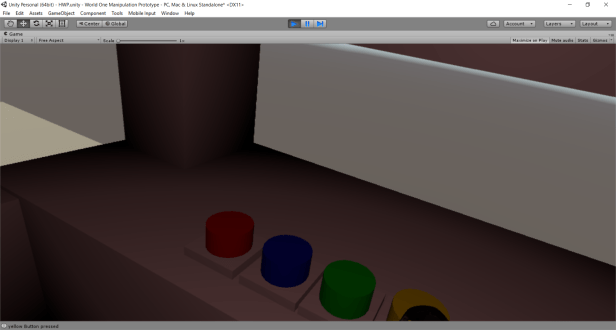
This game was inspired by Keep Talking and Nobody Explodes, and sought to further explore gameplay where one player, using a VR setup, was presented with a number of controls, while one or more additional players relay information to the VR player, telling them which controls needed to be activated. In our game, the additional player (we only had one) was in the back of a spaceship where various things were breaking (water leaks, lighting outages, etc.). This player would tell the VR player what was broken, and the VR player would then have to find the corresponding control in the cockpit of the spaceship to fix all the ship’s systems.
Our motivation for pursuing this type of multiplayer was based on a couple rather obvious facts of VR gameplay:
- If there is only one VR headset (and, at their current price, not many people would have two), then only one person at a time can be playing in VR
- If someone is wearing a VR headset, they won’t be able to see much (if anything) outside of what the HMD is showing them.
With those things in mind, we realized that VR presented a unique way of involving those who weren’t wearing the headset, who would otherwise be just a passive audience to someone else’s experience. By making that audience a key part of a VR game, the technology makes a leap from a fairly solitary experience to the centerpiece of a party-game-like atmosphere.

We feel this experiment worked very well, and certainly reaffirmed that asymmetric co-op is a viable gameplay choice in a VR environment. One of the larger lessons we learned is that giving the non-VR player even a small amount of agency goes a long way. In the first iteration of this game, that player was simply reading out what button the VR player needed to press. By the final iteration, they had a first-person view of a room in the ship, where they could see things breaking for the VR player to fix. Functionally, the non-VR player was doing the same thing, but giving them a physical presence in the game world made the experience much more enjoyable for them. One other thing worth noting is that our VR player only had to press one of several buttons to fix any given system. We are confident that more complex interactions would have added much to that side of the game.
Try this demo out!
 RIT VR Design